


When Diet Food Starts Looking Like Something You’d Actually Want
Dieting usually comes with a fairly simple trade-off. You want to eat less, so you give up some of the foods you enjoy.
Korea has been developing a different kind of diet-food market. Instead of simply making existing foods smaller, lighter, or lower in calories, brands are creating snacks that are meant to feel like snacks in their own right.
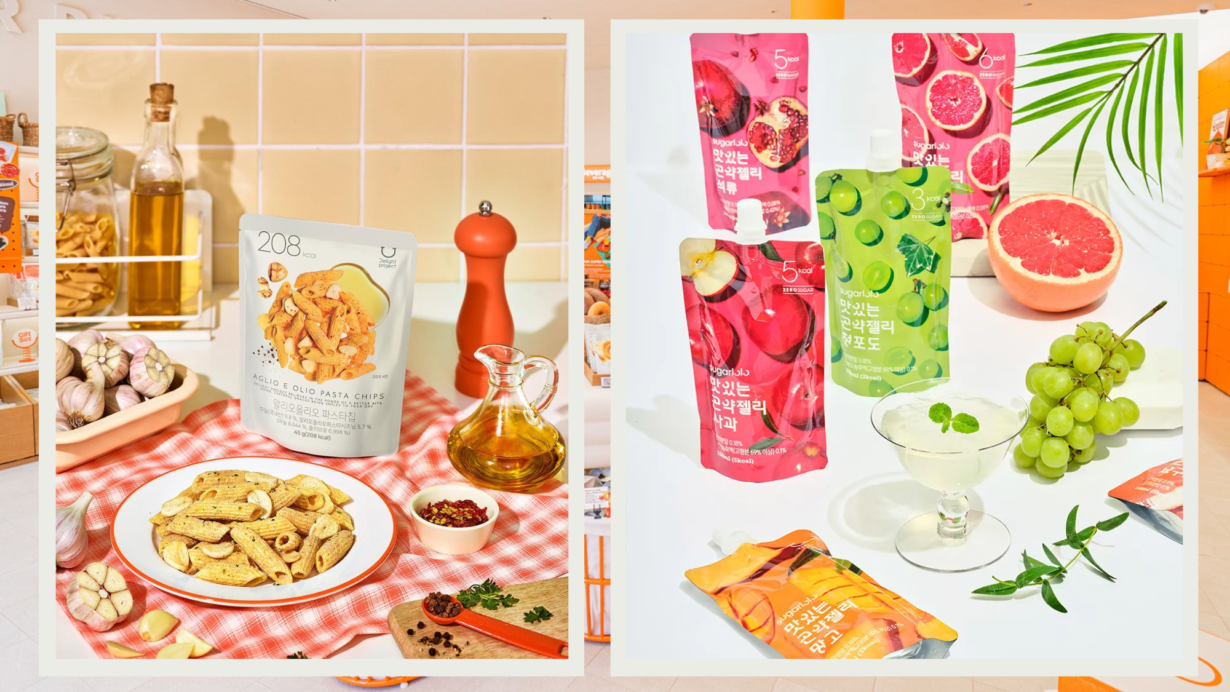
Protein chips still look and eat like chips. Low-sugar popcorn is still popcorn. Protein cookies are still cookies. Konjac jelly comes in portable single-serving pouches and flavors such as lychee and watermelon. The category keeps expanding into more formats, flavors, textures, and packaging styles that make the products feel less like something you buy because you’re dieting and more like something you might actually want to try.
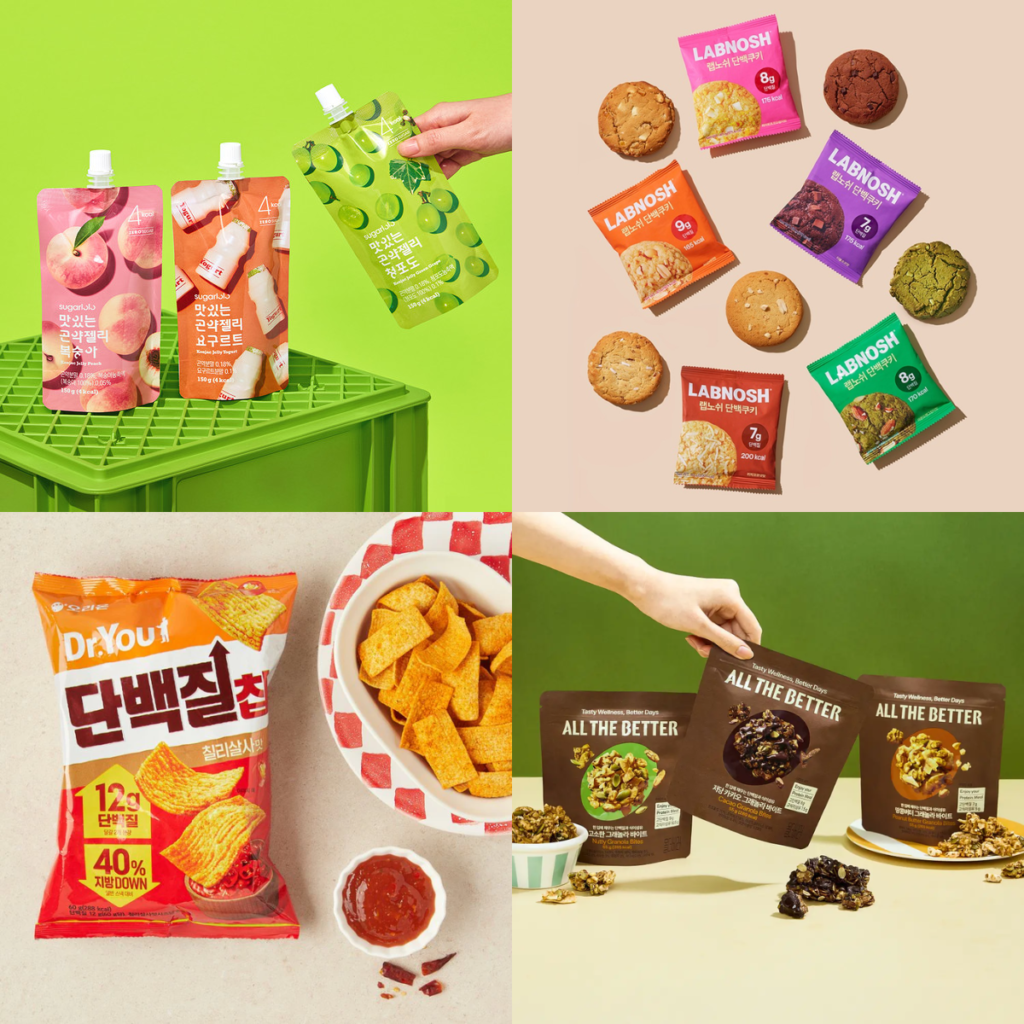
Image: Sugarlolo, Labnosh, Dr. You, All the Better
That’s what makes the Korean market interesting. The competition isn’t just happening between diet products. These brands are increasingly competing with the entire snack market on taste, texture, packaging, convenience, and novelty.
And once diet food starts competing on the same things as ordinary food, the line between the two gets surprisingly blurry.
Part I: What Is Happening in Korea
Ditching the Diet Aesthetic
Diet food has traditionally been quite good at making itself look like diet food.
The packaging often tells you exactly what you’re buying before you even read the label. The design tends to emphasize function, calorie control, protein content, or whatever dietary goal the product is meant to serve. It can feel more like a product for people who have already decided to compromise than something you’d pick up simply because it looks good.
Newer Korean diet snacks are moving away from that visual language.
Many borrow the cues of contemporary snack packaging, but with a noticeably newer design sensibility. The category is relatively young, which means brands aren’t necessarily inheriting decades-old packaging conventions. They’re designing for today’s consumer from the start.
The result can look more playful, polished, indulgent, or even more fashion-conscious than some of the conventional snacks around it. A protein cookie can look like a treat. A low-sugar popcorn can look like something you’d buy for movie night. A protein cracker can look like a snack first and a diet product second.
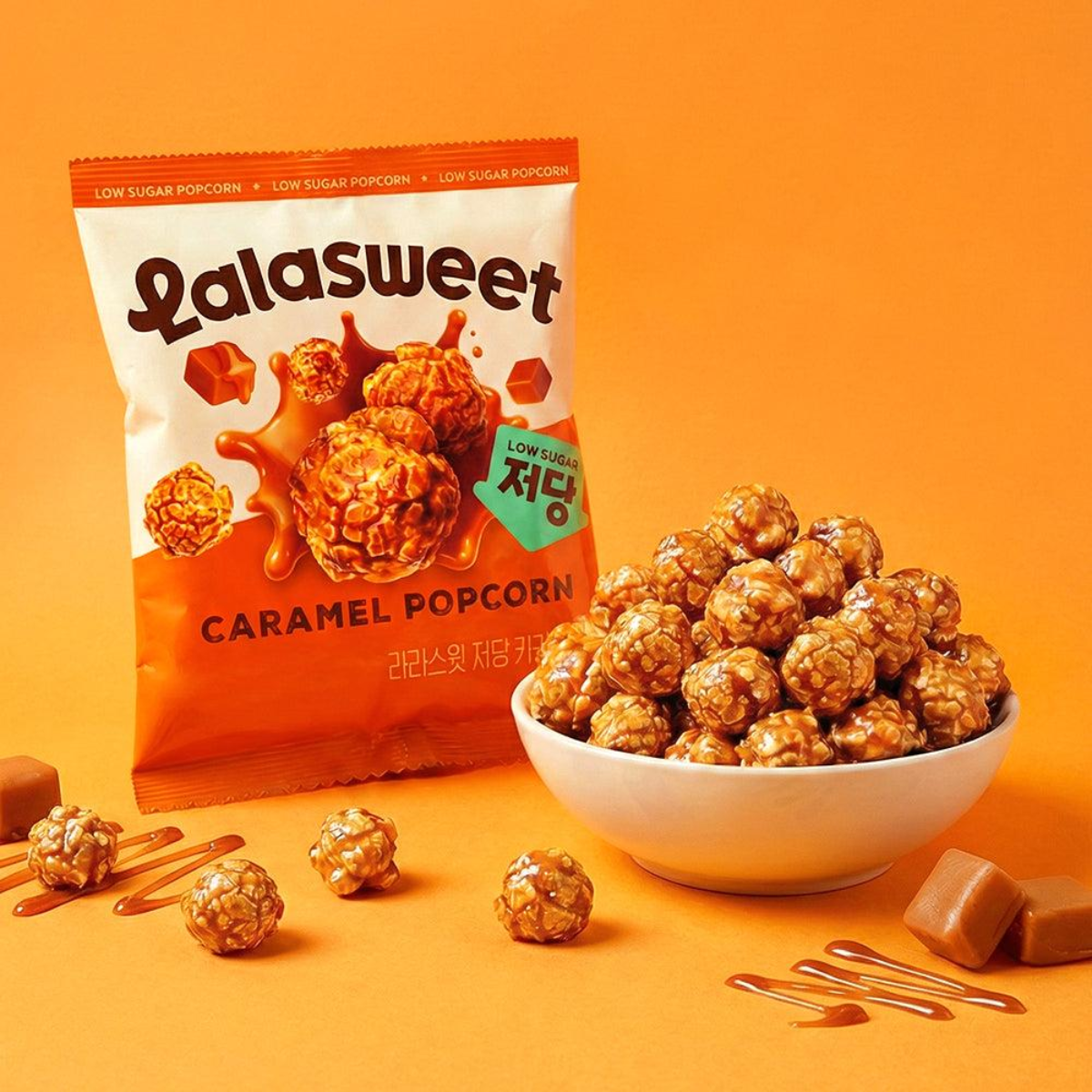
Image: Lalasweet
Put some of these products on a convenience-store shelf among ordinary snacks and the distinction isn’t always obvious.
That’s important because packaging isn’t just making diet food prettier. It’s changing who feels invited to buy it.
A Diet Snack Becomes a Category
Korean brands now offer diet-oriented versions of many of the foods consumers already understand as snacks. Orion’s Dr. You Protein Chips (오리온 닥터유 단백질칩) bring protein into a familiar chip format. Binggrae’s The Protein Pop Chips (더단백 팝칩) take a lighter, puffed approach, while Fromeat Protein Chips (프롬잇 프로틴칩) and Cruntin’s 5mm Whole Potato Chips (크런틴 프사삭 5mm 통감자칩) stay closer to the crunchy potato-chip experience. Labnosh Protein Cookies (랩노쉬 단백쿠키) move into sweet snacking, while Lalasweet’s Low-Sugar Popcorn (라라스윗 저당 팝콘) takes an everyday movie-night format and gives it a diet-friendly positioning.
The point isn’t that Korea has a lot of diet snacks. It’s that there are now enough of them to create choice.
Consumers can choose between something crunchy, sweet, salty, light, protein-focused, or simply low in calories without leaving the broader category. That changes the behavior around diet food. Instead of asking what they have to give up, consumers can start asking which product they want.
And that’s when a category starts behaving more like a real food market than a collection of functional substitutes.
The Category Is Starting to Blend Into Everyday Retail
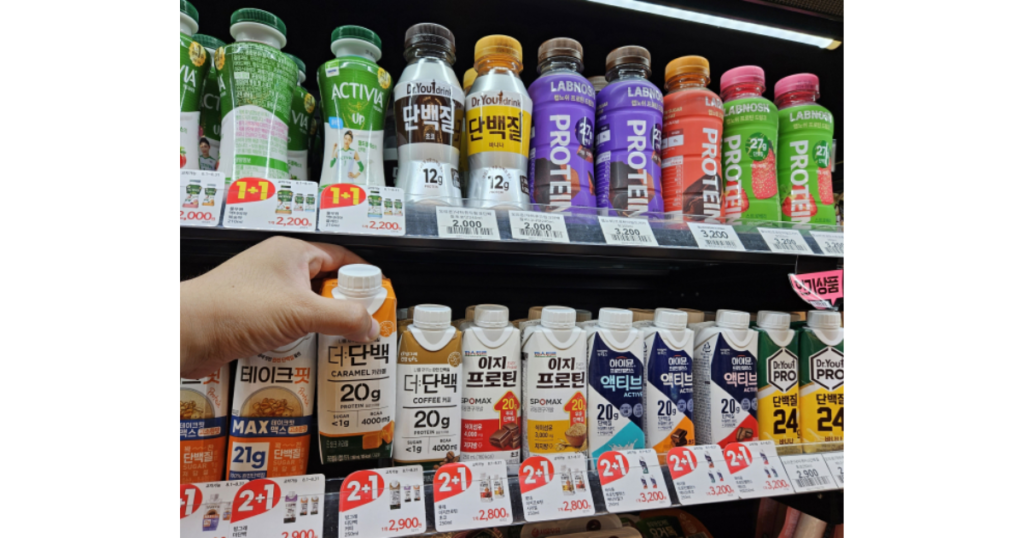
Image: Sedaily
The category is also becoming easier to encounter without actively looking for “diet food.”
Korean convenience stores already carry products such as protein shakes, packaged chicken breast, zero-sugar drinks, and konjac jelly as part of their everyday food selection. Diet-oriented snacks are still less consistently represented than these products, but the boundary is already beginning to blur.
Olive Young provides another important route into the category. Because consumers already visit the retailer for beauty, wellness, and lifestyle products, diet snacks can be discovered in an environment where health-conscious consumption is already part of the shopping mindset. A consumer doesn’t necessarily have to identify herself as someone who shops for diet food before encountering the category.
That matters because distribution changes who gets exposed to a product. The easier it is to encounter these foods during an ordinary shopping trip, the less specialized the category begins to feel.
Social media reinforces that shift. Korean food reviewers, lifestyle creators, and everyday consumers regularly share what they’re eating, buying, and trying, which means diet-oriented snacks can appear as part of ordinary food content rather than only within explicitly fitness or weight-loss content.
A protein chip can be reviewed because it tastes good. A new low-sugar snack can be shared because the packaging looks interesting. A konjac jelly can become something a creator keeps in their bag. The product doesn’t necessarily have to enter the consumer’s life through a “diet” conversation.
That is how the category starts to blend in.
Part II: The Global Question
From Korean Diet Snacks to a Global K-Food Category?
Korean food already has a much larger international footprint than it did a decade ago. Ramen, seaweed snacks, chips, cookies, gummies, beverages, and convenience-store foods are increasingly familiar outside Korea through K-pop, K-dramas, social media, Asian grocery chains, and mainstream retailers.
Korean diet snacks have not reached that level of visibility yet. That’s precisely why they’re interesting to watch.
Konjac jelly offers an early example. Korean-style single-serving jelly pouches have already begun appearing outside Korea, including through Asian grocery retailers and selected mainstream channels. Everydaze’s konjac jelly, for example, has appeared at Costco in the United States, while Korean konjac products are also available through H Mart and other Asian retailers.
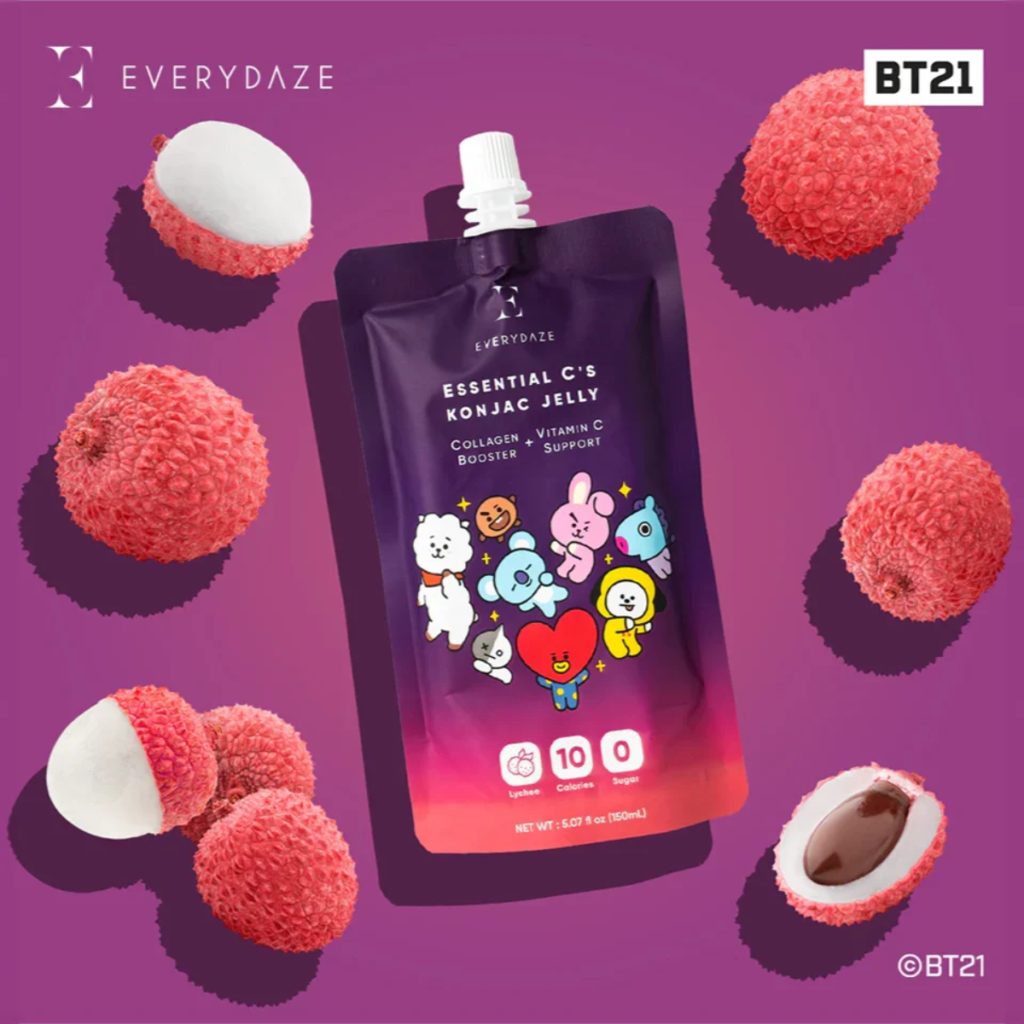
Image: Everydaze
Consumer discovery is happening online too. Reviews and discussions around konjac jelly often focus on the same things that make the category interesting in Korea: very low calorie counts, convenient single-serving formats, and flavors that make the product feel more like a snack than a functional diet product.
That does not mean konjac jelly has become a global mainstream category. It hasn’t. But it shows how a Korean diet-oriented product can enter the same cultural pathway that has already helped other Korean foods travel.
The more interesting question is what happens next.
Korean food is already making the move from Asian grocery shelves into mainstream retailers such as Costco, Walmart, and Target. Korean diet snacks are largely not there yet, with konjac jelly being one of the more visible exceptions. As Korean snacks become increasingly familiar to international consumers, it becomes easier to imagine diet-oriented Korean products following the same path.
But the products that succeed globally will have to compete as food, not simply as Korean products.
A consumer might initially pick up a Korean protein snack because they recognize the brand or are curious about Korean food. The more important question is whether they buy it again because it tastes good, fits their routine, or solves a problem they already have.
That’s the difference between a K-food novelty and a product that becomes part of someone’s everyday consumption.
The Positioning Question Worth Watching
If Korean diet snacks begin moving into more mainstream international retail, the way brands position them will matter.
There are two obvious ways to tell the story. One is to lead with the Korean origin and let K-food familiarity create the initial appeal. The other is to present the product first as a genuinely enjoyable snack that happens to come from Korea and happens to fit a particular dietary goal.
The second approach is likely to have more staying power.
“Korean” can get someone to try a product. It is less likely to make them buy it every week.
That distinction matters for any Korean food brand looking outward. If a product is treated primarily as a Korean novelty, its audience may remain tied to consumers who are actively interested in Korean culture. If the product can stand on its own as a good snack, the potential audience becomes much larger.
The Korean diet-snack market is therefore worth watching not because global brands should copy its products, but because it shows what happens when functional food has to compete with ordinary food on the same terms.
Taste matters. Texture matters. Packaging matters. Convenience matters. And increasingly, so does whether the product gives consumers a reason to come back.
Market Insight
When Diet Products Have to Compete With Everything Else
The more useful lesson from Korea isn’t that diet snacks should look more attractive. It’s that a mature diet market eventually creates a much harder competitive environment.
Korean diet-snack brands aren’t only competing against other products with similar nutritional claims. They’re competing against the snacks consumers already know and enjoy.
That makes the bar considerably higher. A low-calorie chip still has to be crunchy. A protein cookie still has to feel like a cookie. A reduced-sugar snack still has to be enjoyable enough to reach for when there are dozens of conventional snacks sitting nearby.
Once the category reaches that point, innovation starts moving into the details. New flavors, textures, formats, portion sizes, packaging concepts, and usage occasions become ways for brands to differentiate without abandoning the functional reason the category exists in the first place.
For companies watching Korea, this is the signal worth taking seriously. Don’t just track which diet snacks are launching. Watch what Korean consumers are comparing them against, what makes them choose one product over another, and which product attributes are becoming expected rather than novel.
A category becomes much more interesting when consumers stop comparing products only within the category and start comparing them with everything else.
When “Diet” Stops Being the Main Selling Point
Korea’s diet-snack market isn’t interesting because Korean brands invented healthier snacks. They didn’t.
What’s interesting is the direction the category is moving. Diet-oriented products are increasingly being asked to behave like ordinary food. They have to taste good, look good, offer variety, and give consumers enough of a reason to choose them when there are plenty of other snacks available.
That puts Korean diet-snack brands in an unusual position. They are not just trying to make dieting easier. They’re competing at a higher level, against the entire snack market.
Whether that eventually turns Korean diet snacks into a meaningful global K-food category is still an open question. Distribution, price, taste preferences, and attitudes toward dieting will all determine how far the category travels.
But Korea is already showing what happens when diet food stops asking consumers to compromise quite so much.
The interesting part may not be when a diet snack becomes indistinguishable from ordinary food.
It may be when consumers stop thinking of it as a diet snack at all.
Sources
- Costco product listing — Everydaze Essential C’s Konjac Jelly, Collagen + Vitamin C, 30-pack (20 calories, 2,500mg collagen, 500mg vitamin C, multiple flavors): https://www.costco.com/p/-/everydaze-essential-cs-konjac-jelly-collagen-vitamin-c-30-pack/4000039904
- asipoftexas.com — Everydaze Konjac Jelly Costco Review (consumer review including flavor, satiety notes, and practical use): https://asipoftexas.com/everydaze-konjac-jelly-costco/
- Walmart product listing — Tastelli Konjac Jelly (10 calories, collagen + vitamin C): https://www.walmart.com/ip/seort/605371802
- Walmart product listing — Jelly.B Drinkable Konjac Jelly (Korean brand, lychee/watermelon/grape/apple flavors, consumer reviews): https://www.walmart.com/ip/seort/15196765070
- Korea Agro-Fisheries & Food Trade Corporation (K-Food Trade) — “K-Diet Foods for Everyday Wellness”: https://www.k-foodtrade.or.kr/brd/m_106/view.do?seq=738&srchFr=&srchTo=&srchWord=&srchTp=&srchTp2=&srchWord2=&itm_seq_1=0&itm_seq_2=0&multi_itm_seq=0&company_cd=&company_nm=&page=1
- Korea Agro-Fisheries & Food Trade Corporation (K-Food Trade) — “Diversification of Korea’s Snack Market”: https://www.k-foodtrade.or.kr/brd/m_106/view.do?seq=718&srchFr=&srchTo=&srchWord=&srchTp=&srchTp2=&srchWord2=&itm_seq_1=0&itm_seq_2=0&multi_itm_seq=0&company_cd=&company_nm=&page=1
- Korea Agro-Fisheries & Food Trade Corporation (K-Food Trade) — “Korean Snack Market Trends”: https://www.k-foodtrade.or.kr/brd/m_106/view.do?seq=694&srchFr=&srchTo=&srchWord=&srchTp=&srchTp2=&srchWord2=&itm_seq_1=0&itm_seq_2=0&multi_itm_seq=0&company_cd=&company_nm=&page=1
- Seoul Economic Daily — “Low-Sugar Trend Sweeps Korea’s Food Industry, Driving Sales Surge”: https://en.sedaily.com/finance/2026/05/21/low-sugar-trend-sweeps-koreas-food-industry-driving-sales